

Studying to become a professional in the Australian healthcare sector requires dedication. You will face many rules and protocols. The most significant set of rules you must learn is the Aged Care Quality Standards. These standards define what good care looks like for older Australians. They serve as the benchmark for safety and quality across the country.
Many students find the legal text heavy and difficult to memorize. However, you do not need to memorize every single line of legislation. You need to understand how to apply these rules in real scenarios. This guide uses Norma to break down these government standards into actionable steps. Norma helps translate complex language into simple tasks that you can remember.
Key Takeaways
- The Standards focus on consumer outcomes rather than just ticking boxes.
- Norma assists in translating dense legal text into clear actions.
- Clinical governance protects both the resident and the worker.
- You can group the eight standards into logical categories to remember them better.
Understanding the Core Framework
The Australian government designed these standards to protect consumers. A consumer is the person receiving care. When you enter a facility, you must verify that every action supports the consumer's dignity and choice.
The framework consists of eight individual standards. Each one covers a different part of the aged care experience.
- Standards 1-3: Focus on the individual resident and their immediate care.
- Standards 4-5: Focus on the environment and daily lifestyle.
- Standards 6-8: Focus on the organization and how it runs.

You should view these not as hurdles, but as a safety net. They exist to direct your decisions when you are unsure.
Simplifying Healthcare Regulations with Norma
Reading through pages of healthcare regulations is tiring. It is easy to miss important details when the language is overly formal. This is where Norma helps. Norma acts as an interpreter for these regulations.
Norma takes a complicated requirement and asks: "What does this mean for the student on the floor?"
How Norma Breaks It Down
Instead of memorizing a long paragraph about "dignity of risk," Norma simplifies it to:
- Ask the resident what they want to do.
- Explain the risks clearly.
- Support their choice if possible.
- Document the conversation.
This method turns abstract concepts into a checklist. You can apply this logic to every task you perform. Technology often assists in this learning process. Modern tools specifically designed for AI for aged care can help you practice these scenarios before you start your placement.
Clinical Governance in Daily Practice
Clinical governance sounds like a term for managers, but it applies to students too. It simply means having a system to account for safety and quality. When you are on placement, you are part of this system.
You contribute to good governance by:
- Reporting mistakes immediately.
- Checking care plans before acting.
- Asking for help when a task is beyond your skill level.
- Following infection control procedures strictly.
Norma reminds you that governance is about responsibility. If you see something unsafe, you must speak up. This protects the resident from harm and protects you from liability.
The Eight Standards: A Quick Reference
Here is how Norma summarizes the eight standards for quick memorization. You can use this list to recall the main goal of each standard during exams or practical assessments.
Standard 1: Consumer Dignity and Choice
Goal: The consumer runs the show.
- Treat everyone with respect.
- Respect their culture and identity.
- Support them to take risks safely.
Standard 2: Ongoing Assessment and Planning
Goal: Know what the consumer needs right now.
- Read the care plan.
- Notice changes in health or mood.
- Partner with the consumer to plan their day.
Standard 3: Personal and Clinical Care
Goal: Keep the consumer safe and healthy.
- This is the core of nursing compliance.
- Manage medication correctly.
- Prevent falls and infections.
- Manage complex health needs properly.
Standard 4: Services and Supports for Daily Living
Goal: Support a good life, not just clinical needs.
- Help them engage in hobbies.
- Support emotional and spiritual well-being.
- Make sure meals are enjoyable and nutritious.
Standard 5: Organisation’s Service Environment
Goal: The facility must be safe and welcoming.
- Keep equipment clean.
- Report broken furniture.
- Make sure the space feels like a home, not a hospital.
Standard 6: Feedback and Complaints
Goal: Listen when things go wrong.
- Encourage residents to speak up.
- Do not take complaints personally.
- Apologize and fix the issue if you can.
Standard 7: Human Resources
Goal: Staff must be skilled and kind.
- This applies to you as a student.
- Maintain your training.
- Behave professionally at all times.
Standard 8: Organisational Governance
Goal: The organization must be well-run.
- This involves the managers and board.
- Your role is to follow the policies they set.
- participate in quality improvement activities.
Nursing Compliance Made Simple
Compliance often scares students because it implies punishment for doing things wrong. However, compliance is actually about consistency. It means doing the right thing every time, even when no one is watching.
Norma suggests focusing on three main areas to stay compliant:
- Documentation: If you did not write it down, it did not happen. Record your actions accurately.
- Consent: Always ask for permission before touching a resident or providing care.
- Scope of Practice: Know what you are allowed to do. Never perform a procedure you are not trained for.
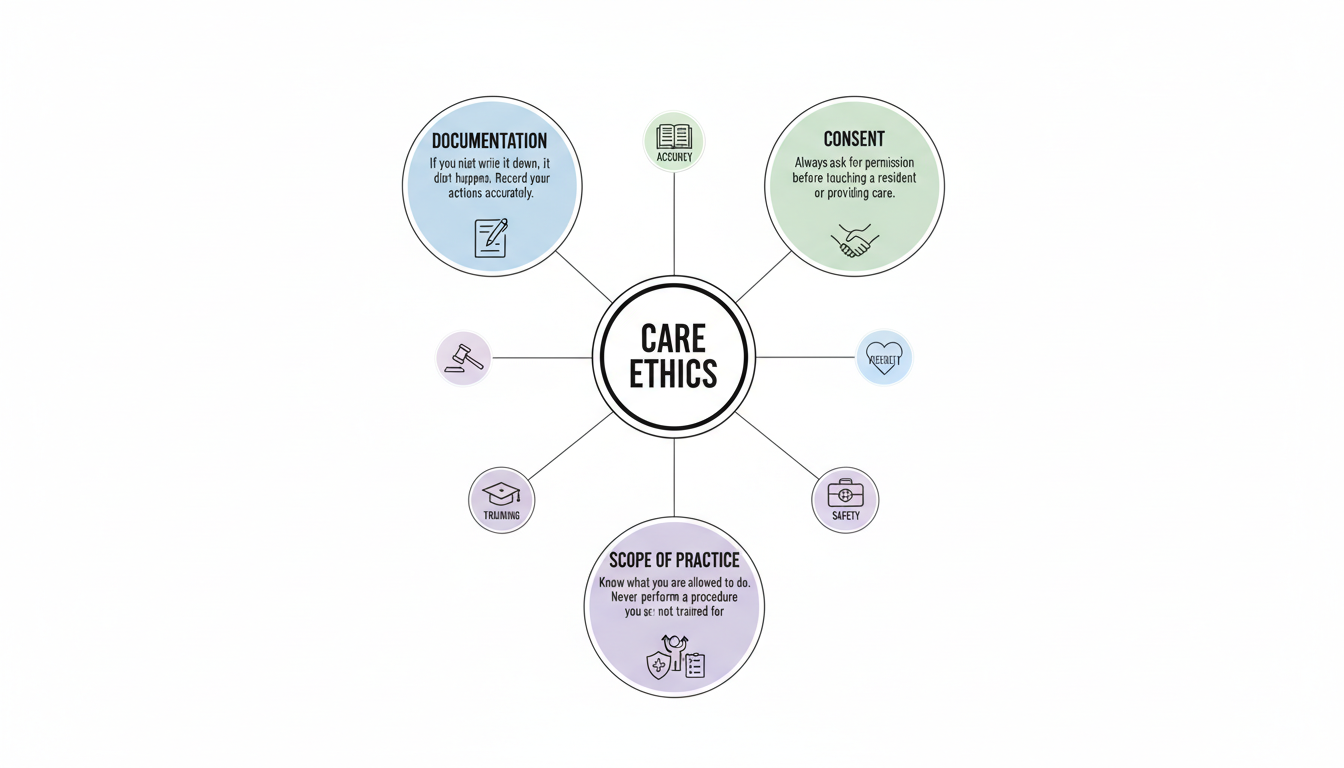
By sticking to these three pillars, you will satisfy most healthcare regulations naturally. You do not need to be a lawyer; you just need to be diligent.
Tips for Memorization
- Group the standards: Remember "People" (1-3), "Place" (4-5), and "Process" (6-8).
- Use flashcards: Write the standard on one side and Norma's simple explanation on the other.
- Roleplay: Practice explaining a standard to a friend in plain English.
Frequently Asked Questions
What happens if I make a mistake with a standard?
Mistakes happen. The most important action is to report it immediately to your supervisor. Hiding a mistake is a breach of integrity and safety. Reporting it shows you understand clinical governance and safety culture.
Do I need to know every sub-clause of the legislation?
No. As a student, you need to understand the intent and the main requirements of each standard. You must know how to apply them to basic care tasks. You can look up specific details in policy documents when needed.
How does Norma help with specific clinical tasks?
Norma breaks down clinical tasks into steps that align with the standards. For example, if you are helping with wound care, Norma reminds you of the hygiene requirements (Standard 3) and the need to explain the process to the resident (Standard 1).
Your Future in Aged Care
Mastering these standards is the first step toward a successful career. When you understand the Aged Care Quality Standards, you offer better care to your patients. You also become a more valuable asset to any employer.
Use the strategies in this guide to simplify your study process. Lean on tools like Norma to translate complex government rules into clear, daily actions. By focusing on the resident and following safety protocols, you will naturally meet the requirements. Stay curious, ask questions, and commit to safe practice. Your dedication creates a better environment for older Australians.